Boundaries Aren't Rude. They're The Only Reason Your Agency Survives Past Year Two.
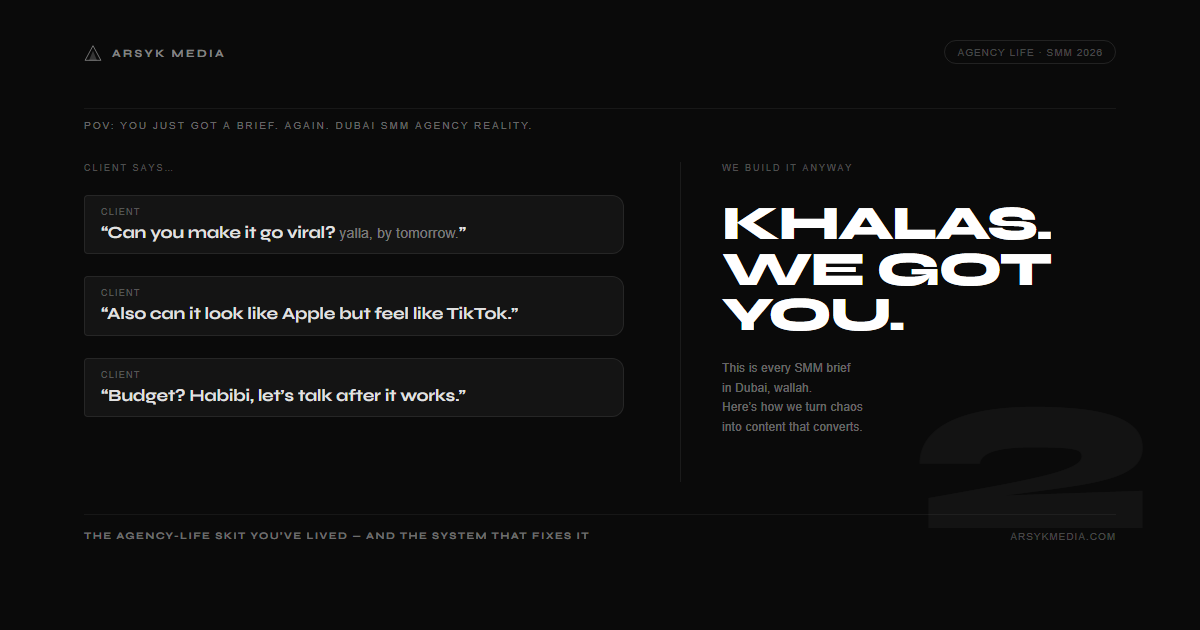
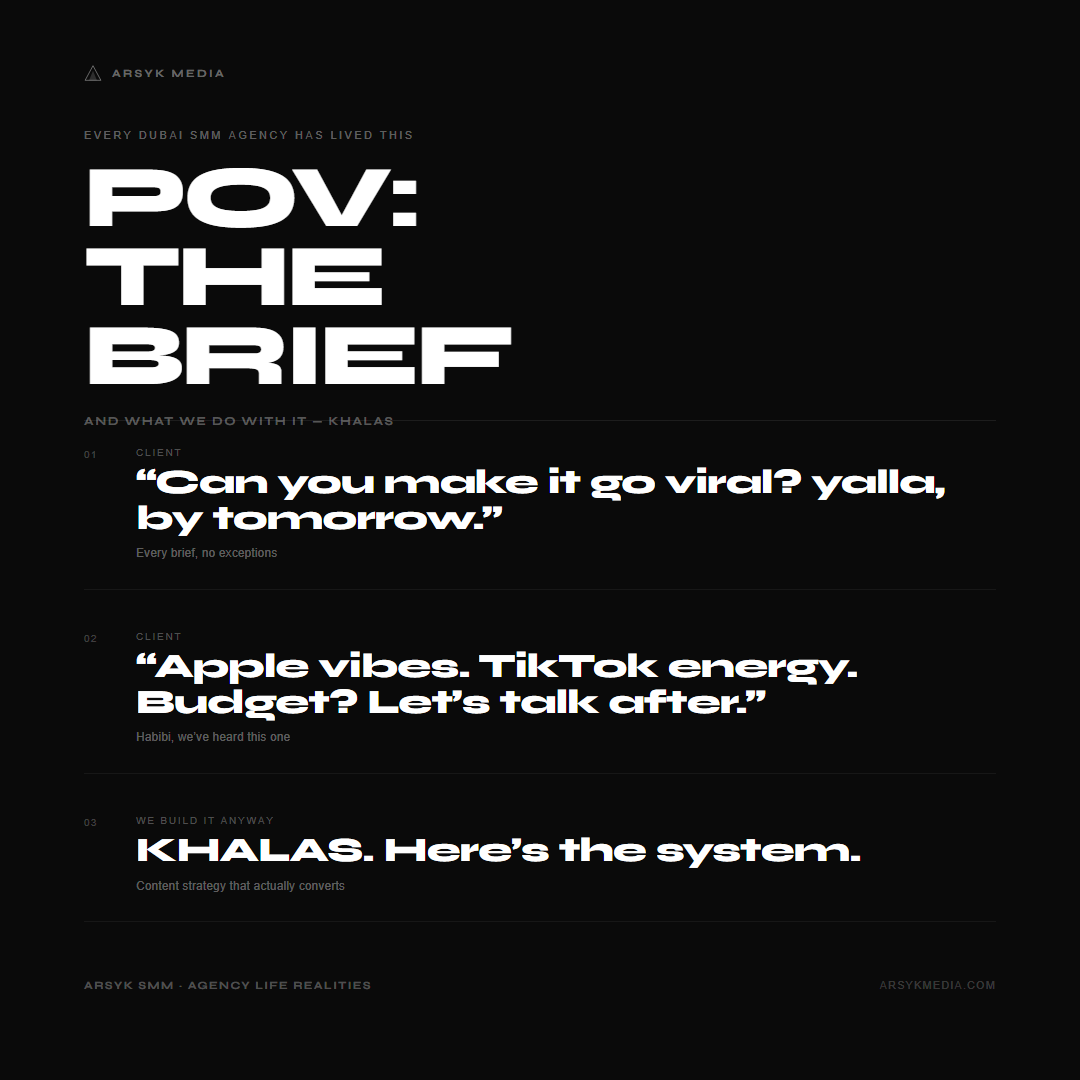
The Reel was honest about something most agency owners in Dubai will not say out loud: the work is not what burns you out. The relationship is.
I have run Arsyk for long enough to watch other agencies open, sprint, and close inside 18 months. Almost none of them closed because the work was bad. They closed because the relationships became unsustainable — the client who texts at 11 PM, the "just one quick change" that was the eighth one this week, the brief that asks for "viral" and means "I will be disappointed no matter what you ship."
The five boundaries below are non-negotiable at Arsyk. We set them before the contract is signed. We sign them alongside the contract. We refer to them every time a request crosses one of them.
If you are an agency owner reading this, copy the list. If you are a business owner briefing an agency, this is what your agency should be telling you on day one. Khalas.
Why Most Agencies Don't Set Boundaries (And What Happens When They Don't)
I will tell you exactly why I did not set these boundaries in my first year. Because I was afraid of losing the deal.
Every agency owner thinks the same thing the first few times a client asks for something outside scope: "if I push back, they will leave, and I cannot afford that right now." So you say yes. You absorb the request. You write it off as "relationship building." Three months later, you are working 60-hour weeks for a client paying you AED 4,000 a month, your team is exhausted, and you are losing money on the account.
The clients who respect boundaries become long-term retainers. The ones who do not were never your clients to begin with — they were a problem you mistook for revenue.
The cost of saying yes to everything is bigger than the cost of losing one deal. I have lost team members because of one impossible client. I have missed deliverables on three good accounts because one bad account consumed my bandwidth. The math always catches up.
What follows is the system that fixed it. Five boundaries, set in writing before any work starts, enforced calmly when needed.
Boundary #1 — No WhatsApp After 7 PM
WhatsApp is the default communication channel in Dubai. It is also the single biggest reason agency teams burn out here.
The pattern is universal. A client sends a "quick" message at 9:30 PM Thursday. You see it. You feel obligated. You reply. They reply back. Suddenly you are workshopping campaign ideas at 10:45 PM the night before your kid's birthday. The boundary did not exist, so the conversation expanded to fill all available time.
Our rule: WhatsApp is a relationship channel, not a work channel. All work happens in a project tool — ClickUp, Notion, Asana, or a dedicated Slack channel. WhatsApp stays open for the human moments: a quick check-in, an event invite, a celebration. Anything that affects the work — feedback, change requests, deliverable reviews, scope discussions — goes through the project tool.
Two reasons this works. First, the project tool is searchable across the team, so decisions do not vanish in a chat thread one team member happens to be in. Second, the act of writing a request in a project tool forces the client to be specific. "Make the title bigger" becomes a documented task with a screenshot and an explanation. Half the "quick" requests die in the writing process because the client realizes they were not actually requests, just thoughts.
Set it on day one. Enforce it on day thirty. Habibi, you have a project tool for a reason.
Boundary #2 — No "Just One Quick Change"
"Just one quick change" is the most expensive sentence in agency work. Not because of the change itself. Because of the precedent.
Every change has implementation, review, testing, and deployment time attached to it. Ten "quick changes" in a month is forty hours of unbilled work. That is one full-time week your agency just gave away. Multiply that across a portfolio of five clients and you have built a charity.
The boundary: every change is scoped, or it becomes a new SOW. The wording matters. "I am happy to make that change — let me send a change order. It takes fifteen minutes to write up and includes the new timeline." Most clients accept it without complaint. The ones who push back are revealing exactly what working with them long-term will be.
This is not about being precious with time. It is about respecting the agreement both sides signed. The contract had a scope. The scope had a price. The price funded a team that has to be paid. When the scope expands without the price expanding, somebody is absorbing the cost — and that somebody is your team's evening, your weekend, and eventually your business.
Document everything. Brief, scope, revisions, approvals — all in writing, all timestamped, all in the project tool. The day you discount mid-project without a scope reduction, you have told the client that your prices are negotiable under pressure. You will have that conversation again. And again.
Boundary #3 — No "Make It Viral" As A Brief
Virality is a result, not a deliverable. We can engineer the conditions for reach. We cannot guarantee a cultural moment.
When a client says "make it viral," what they actually mean is "I want a feeling — the feeling of seeing my brand referenced everywhere for a week." That feeling depends on factors no agency controls: a competing news cycle, an audience's mood, a platform algorithm change, the timing of a holiday. Promising virality is promising weather.
The reframe we use: "What does success look like in your DMs by the end of the month?" That question moves the conversation from a vague aesthetic to a measurable outcome. Saves. Shares. Comment-keyword DM triggers. Conversion rate. Lead quality. All of those are achievable, trackable, and actually move the business. Virality, if it happens, is a side effect of doing those things well.
For how this looks in practice, the 3-types Reel framework is what we run for SMM clients — Authority Reels engineered for saves, Case Study Reels engineered for shares, Trial Reels engineered for cold reach. Specific mechanics for specific outcomes. None of them have "go viral" written as a deliverable, but several of them have gone viral. That is the order it works in: build the system, the system produces the results, the results occasionally produce a moment.
If a prospect insists on "viral" as the only KPI, we decline politely. They are buying lottery tickets, not marketing.
Boundary #4 — No Revisions Without Written Feedback
Voice notes are excellent for relationships. They are catastrophic for revisions.
I have lost more billable hours to ambiguous voice-note feedback than to any other single thing. "Make it pop" in a 17-second voice note. "It feels off" with no specifics. "Can we make it more like that brand we discussed once?" referring to a brand never named. By the time you have transcribed, interpreted, and acted on a voice note, you are halfway to a wrong revision the client will reject.
The rule: every revision request comes in writing, in the project tool, with the specific change identified. We provide a revision form template — three mandatory fields: what to change, what it should look like instead, why. Voice notes welcome for chat. Never for revisions.
This boundary saves more time than any other. Written feedback forces specificity. "The title is too small" is actionable. "Make it pop" is not. The thirty seconds it takes a client to type a request usually surfaces whether the request is real or just a vibe — and vibes do not survive the typing process. Wallah, this single rule has saved Arsyk hundreds of hours per year.
The diplomatic version when introducing the boundary: "We treat your feedback as part of the official record, so it goes in the project tool. That way nothing gets lost in voice notes and your changes ship faster." Most clients hear "your changes ship faster" and immediately agree.
Boundary #5 — No Discounts For "Exposure"
Exposure does not pay rent in Dubai. It does not pay your team. It does not pay your software stack. It is what brands offer when they do not want to pay you in actual money.
The pitch usually arrives wrapped in flattery: "We have an amazing audience and would love to feature you on our channel — could you do this project at cost?" The unspoken offer is that you will gain something intangible by association. In practice, what you gain is one Instagram tag and a project that consumed two weeks you could have billed elsewhere.
The math is simple. If a client offering exposure had an audience that was actually convertible into your future business, they would have a marketing budget. The brands with the most useful audiences for an agency — established Dubai businesses, well-funded scaleups, owner-operators with real revenue — pay agency rates without flinching. The ones aggressively pitching exposure are usually the ones with no budget and no track record of converting their audience into anyone's revenue.
Real partnership exceptions: equity stakes (real ownership in real upside), guaranteed referrals locked in writing with measurable terms, or barter arrangements where the value is documented and roughly equivalent to your fee. None of those is "exposure" — they are real economic exchanges with real consideration on both sides.
Decline politely. Send a one-line: "Thanks for considering us — we do not take on engagements at cost. If the budget shifts, happy to talk." The brands that come back with budget become great clients. The ones who do not were always going to be a story you tell other agency owners over coffee.
Saw the Reel? Comment BOUNDARY on it — we'll DM you the full client agreement template Arsyk signs before every project starts.
→ Instagram: @arsyk.media
How We Actually Use The Boundaries Doc
The boundaries are not a list we keep in our heads. They are a one-page document we send during onboarding, signed alongside the contract, referenced whenever a request gets close to crossing one of them.
The phrasing in the doc is professional, not adversarial. Each boundary is framed as a system that protects the work, not as a restriction on the client. "We use a project tool for all work-related communication so decisions are documented and your changes ship faster" lands very differently than "Do not WhatsApp us." Same boundary, different framing, same outcome.
When a request crosses a line — a 9:30 PM WhatsApp, a "quick change" that is not quick, a voice-note revision — we point back to the doc. "Per our agreement, change requests go in the project tool — happy to action this once it is logged there. Takes thirty seconds." Calm. Documented. Repeatable.
The difference between an agency that survives and one that closes is rarely the quality of the creative. It is whether the agency built a system that protects the team's time, the client's expectations, and the relationship's longevity — before the first invoice was sent.
The Truth About The Dubai Agency Market
Dubai is a phenomenal market to run an agency in. Clients here move fast, spend seriously when convinced, and refer loudly when results land. The energy is real. The opportunity is real.
But the same speed that makes Dubai exciting also punishes vague agreements. The market rewards clear processes and ruthless execution. It does not reward agencies that absorb scope creep, work weekends to compensate for poor scoping, and burn out their team to keep one toxic client happy. Those agencies do not last.
The agencies operating in Dubai for five-plus years all share one thing: they say no a lot. They turn down briefs that do not have measurable KPIs. They walk away from clients who refuse boundaries. They sleep at night because they know exactly which work they accepted and what the rules of engagement are. Boundaries are not arrogance — they are the operating manual that makes longevity possible.
The clients who respect them become five-year retainers. The ones who do not were never going to be sustainable revenue.
Frequently Asked Questions
What boundaries should a marketing agency set with clients?
Five boundaries are non-negotiable for a sustainable marketing agency: (1) No WhatsApp after 7 PM — all work happens in a project tool. (2) No "just one quick change" — every change is scoped or becomes a new SOW. (3) No "make it viral" as a brief — virality is a result, not a deliverable. (4) No revisions without written feedback — voice notes don't count. (5) No discounts for "exposure" — exposure doesn't pay rent. These boundaries are set before the contract is signed, not improvised when problems arrive.
How do you tell a client about boundaries without sounding rude?
Boundaries are framed as the operating system that protects the work, not as restrictions on the client. They go in the onboarding document and are signed alongside the contract. Most clients appreciate the clarity — they want to know what "good" looks like. The phrasing matters: "Here is how we work to deliver consistent quality" lands very differently than "Here is what we won't do." Boundaries explained as a system are professionalism. Boundaries explained as a list of nos are friction.
What if a client refuses the boundaries?
A client who refuses every reasonable boundary at onboarding is telling you exactly what working with them will look like. The right move is to decline politely. The agencies that survive past year two are the ones that learned this lesson early. The lost revenue from saying no to a bad-fit client is always less than the cost of taking them on — measured in team burnout, missed deadlines on other accounts, and the months you cannot bill anyone else because this client consumes your bandwidth.
Why no WhatsApp for project work?
WhatsApp is a relationship channel, not a work channel. Messages aren't searchable across the team, decisions vanish in chat threads, and "quick" requests bleed into evenings and weekends. A project tool (ClickUp, Asana, Notion, Slack with proper channels) keeps work documented, searchable, and asynchronously workable. WhatsApp stays for relationship moments — a quick check-in, an event invite, a celebration. Everything that affects the work goes through the project tool.
Why is "make it viral" a bad brief?
Virality is an outcome that depends on cultural moments, audience psychology, and timing — none of which are fully controllable. An agency can engineer the conditions for reach (3-type Reel rotation, hook engineering, amplification stack) but cannot guarantee a viral moment. A good brief replaces "make it viral" with measurable KPIs: saves, comments, DMs triggered, conversion rate, lead quality. Those are achievable, trackable, and actually move the business — virality is a side effect, not a goal.
Should I do work for exposure?
No. "Exposure" is what brands offer when they don't want to pay. The clients who offer it most aggressively are usually the ones with the least useful audience for your business. Real partnerships have agreed fees and agreed deliverables in writing. The legitimate exceptions are equity stakes (real ownership in real upside) or contractually guaranteed referrals — not vague promises of "amazing exposure to our network." Exposure does not pay rent in Dubai or anywhere else.
What does a client agreement template include?
A complete client agreement covers scope of work (deliverables and exclusions), success metrics tied to the brief, the boundaries (after-hours, change orders, written feedback, no exposure work), payment terms, revision limits, ownership and IP, termination clauses, and a change-order process for additions. Arsyk's template is the exact one we sign with every Dubai client before a single line of work begins — comment BOUNDARY on the Reel and we will DM it to you.
The Offer
You have the boundaries. Five rules, set in writing, enforced calmly. Run them at your agency and the worst-case clients self-select out before they cost you a year of your life.
If you want Arsyk to run your social, every package includes the boundaries doc, the onboarding flow, the client agreement template, and the project tool setup. Standard at AED 4,000/month. Platinum at AED 15,000/month. Everything in between is a function of post volume and the depth of the stack you want behind it:
- Standard — AED 4,000/month. Content production, posting, ad campaigns, 10 posts per platform per month.
- Silver — AED 6,500/month. Everything in Standard plus brand identity, strategy, account manager, 16 posts per platform per month.
- Gold — AED 10,000/month. Everything in Silver plus custom website and AI chatbot, 20 posts per platform per month.
- Platinum — AED 15,000/month. Everything in Gold plus app development and CRM automation, up to 26 posts per platform per month.
Be Honest — What's The Worst Thing A Client Has Ever Texted You After Hours?
DM us on Instagram at @arsyk.media or WhatsApp us at +971 50 679 5300. Comment BOUNDARY on the Reel and we will DM the full client agreement template — the exact one we sign before every project starts. Yalla.
View Our Packages →