The System Behind the Claim
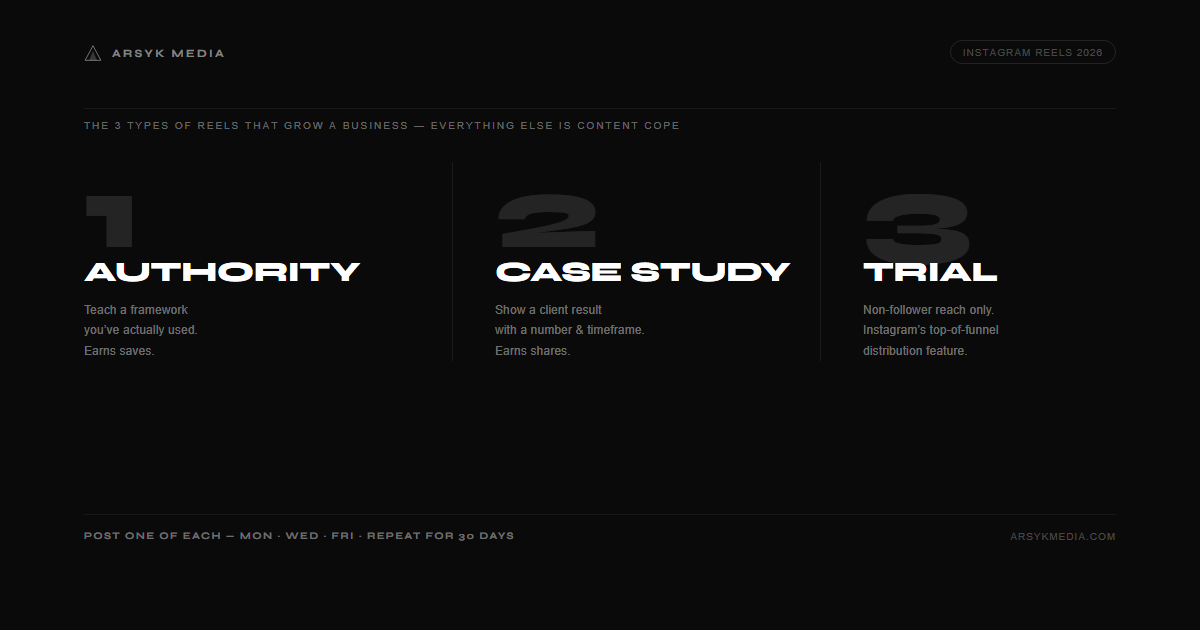
You saw the Reel. Three types. Everything else is content cope.
That was 28 seconds. This is the system underneath it — the full framework we run for every SMM client, so you can see exactly why it works and how to build it yourself.
Most businesses post Reels the same way they send newsletters: on a vague schedule, without a theory of what each piece is supposed to do. The result is a feed that looks fine, gets some views, and moves nothing. No saves. No DMs. No new clients.
The 3-type system fixes this because it starts with function, not format. Every Reel you publish should be doing one specific job. Once you define the job, the format, length, caption, and CTA all write themselves. When those three types rotate in the right order, the algorithm trains on your account, discovery compounds, and the content starts paying for itself.
That is the claim. The rest of this article proves it.
Why Most Reels Fail (and It Is Not the Algorithm)
Here is what most agencies pitch when they sell social media management: trending audio, niche hashtags, consistent posting, and "engaging content." Then they show you a watch-count graph and call it a win.
Watch counts are not revenue. The algorithm does not care how many people passively scrolled past your video. It cares about saves, shares, replays, and DM triggers — signals that tell Instagram this content is worth pushing to non-followers.
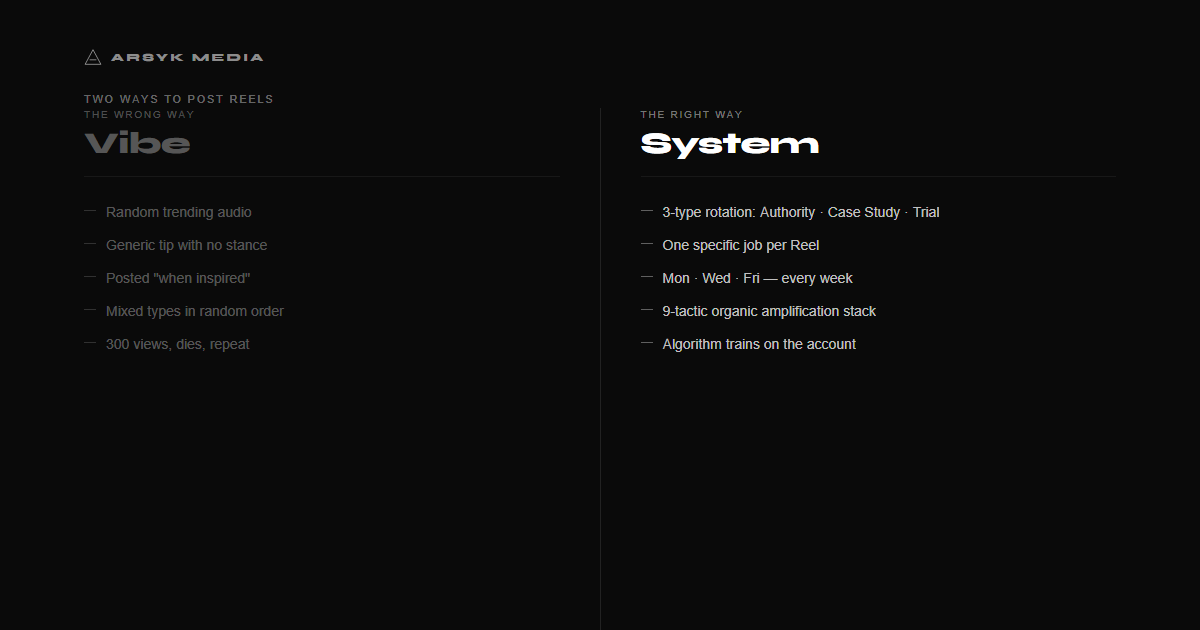
The underlying problem is that most Reels are made by vibe, not by architecture. Someone picks a trending sound, hooks it to a generic tip, posts it at noon because some infographic said noon is "peak time," and waits. The video gets 300 views from existing followers and dies. Next week they do it again. The account plateaus.
The vibe approach fails because it treats every Reel as the same type of content with the same job. But a video meant to build trust has a completely different structure than a video meant to generate reach. Mixing those up — or worse, optimizing for neither — is why most content produces zero business results.
There is a second failure mode that is harder to diagnose: agencies that do post frequently, post real content, and even post well — but without a rotation strategy. They go three weeks of Authority-style posts, burn the audience on education, then pivot to case studies with no bridge. The account never builds momentum because the algorithmic signal keeps shifting.
The 3-type rotation solves both problems. Each type has a job. The rotation creates a weekly rhythm the algorithm can learn. And once the algorithm learns, discovery stops being random.
The 3 Types: What They Are and What They Do
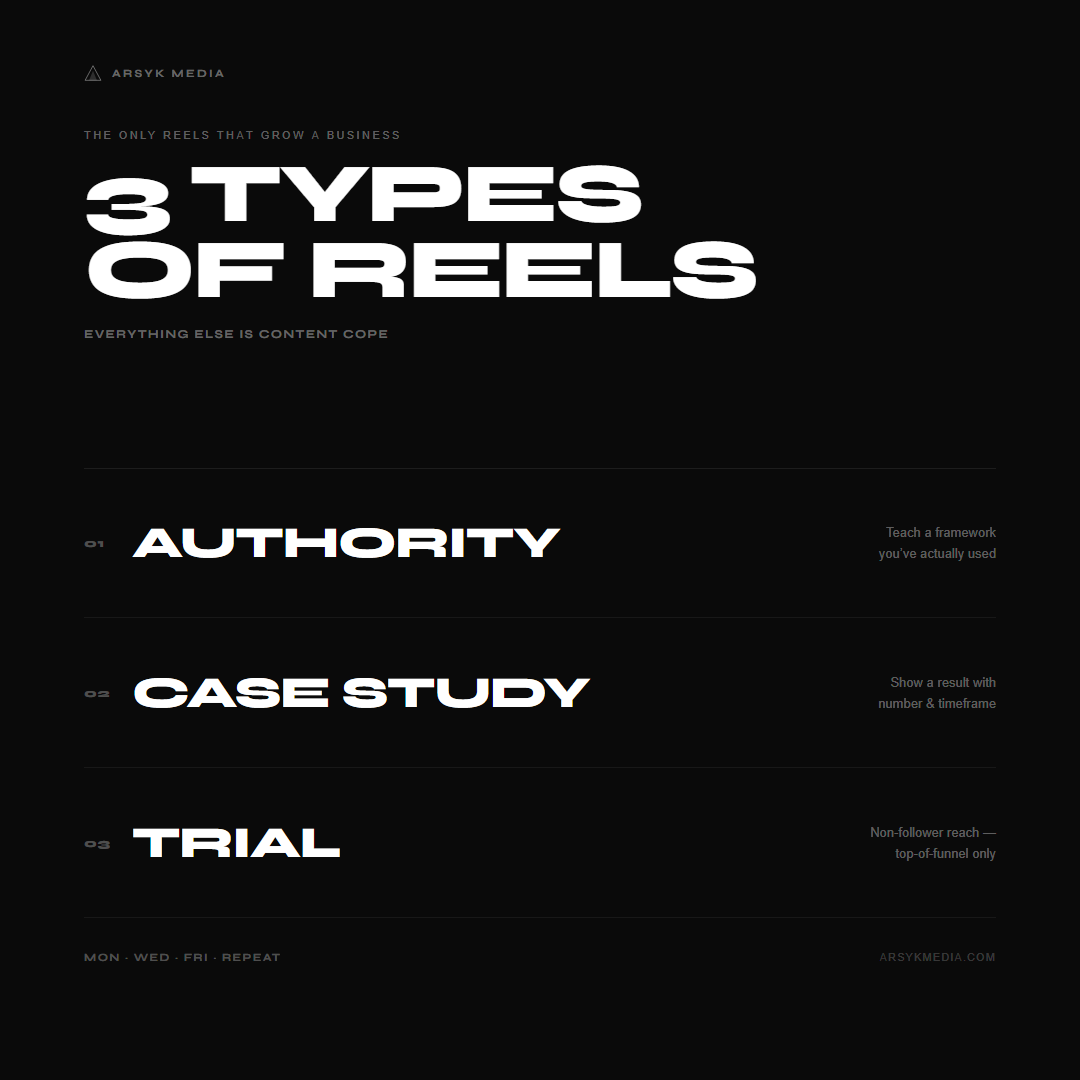
Authority Reels earn saves. Case Study Reels earn shares. Trial Reels earn reach. Each type serves a different algorithmic function — and each one fails when used for the wrong job.
Type 1 — Authority Reel. A short, opinionated breakdown of a framework you have actually used. It does not sell. It teaches. The job is to earn trust and trigger saves. An Authority Reel that gets saved becomes a ranking asset that works for weeks after posting because the save signal compounds inside Instagram's distribution model.
Type 2 — Curiosity Case Study Reel. Opens with a specific number and a specific timeframe: "This restaurant went from AED 95K to AED 310K a month in 8 months." The job is to generate desire and shares. Specificity is the mechanic — when a viewer sees a number that matches their pain or aspiration, they share it with someone who has the same problem. That share extends your reach to warm audiences who already trust the person who shared it.
Type 3 — Trial Reel. Instagram's Trial Reels feature shows this content only to non-followers. It is the only organic mechanism on the platform that guarantees your content reaches people who have never heard of you. The job is pure top-of-funnel reach. Its structure is completely different from the other two types because the viewer has no context for who you are or why they should care.
Three types. Three jobs. One rotation. Let's go deep.
Type 1: The Authority Reel
What It Is
An Authority Reel is a 20–30 second teaching piece built around a specific framework you have used with real results. Not a "5 tips" listicle. A framework — a structured sequence that explains why something works, not just what to do.
The difference matters. "Post consistently" is a tip. "Post Monday Authority, Wednesday Case Study, Friday Trial because that rotation trains the algorithm in 30 days" is a framework. One is forgettable. The other gets saved.
Why It Works
Saves are the strongest single predictor of subsequent reach we measure across our SMM client accounts. When someone saves your Reel, they are telling the algorithm: "I want to come back to this." Instagram reads that as high-quality content and pushes it to more people. In our client data, Reels with high save rates consistently outperform Reels with high like counts in subsequent reach — by a wide margin.
Authority Reels generate saves because they are useful and specific. A viewer watching a genuinely useful framework does not just double-tap. They hit save because they want to reference it later. That save signal compounds — more saves means more reach, which means more non-followers see it, which means more saves from people who did not already follow you.
The Anatomy
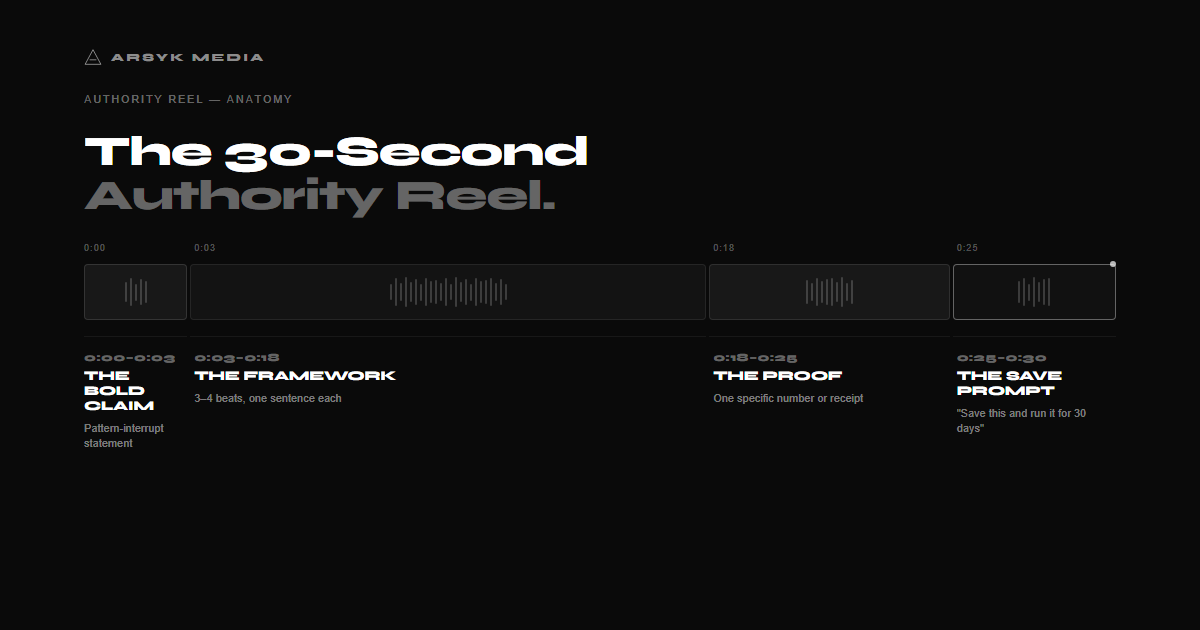
A 30-second Authority Reel has four zones:
- 0:00–0:03 — The bold claim. Not a question. Not a soft opener. A direct statement that creates a pattern interrupt. "There are only 3 types of Reels that grow a business. Everything else is content cope." The viewer should immediately think: "okay, tell me."
- 0:03–0:18 — The framework. Three to four beats, delivered fast. Name each step or type. Keep each beat to one sentence. No padding.
- 0:18–0:25 — The proof or receipt. One specific number or real outcome that validates the framework. This is what separates a convincing Authority Reel from a generic opinion piece.
- 0:25–0:30 — The save prompt. Not a follow CTA. A save CTA: "Save this and run it for 30 days." Saves are the signal you are engineering for.
Common Mistakes
The most common mistake is lecturing — talking at the audience instead of giving them a concise tool they can use. If your framework takes more than 15 seconds to explain, it is not a Reel, it is a podcast episode. Cut it to the bones.
The second mistake is having no opinion. "Here are some tips" is not an Authority Reel. "Here is the one framework most agencies get wrong, and here is why" is. Take a stance. The algorithm does not reward neutral content. Neither does an audience looking for someone who actually knows what they are doing.
The third mistake is no payoff line. The proof zone at 0:18 is not optional. If you claim a framework works but offer no evidence, you are asking the viewer to trust you on faith. Specific numbers close that gap.
How This Plays Out for Clients
When we ran this structure for Jano Auto Workshop, an Authority Reel on BMW service intervals generated more saves in the first 48 hours than their previous six posts combined. The content drove qualified inbound — not because we "went viral," but because BMW owners in Dubai who care about their cars searched that topic, found the Reel, and landed in the funnel. Jano went from 38 to 167 monthly enquiries. The app we built alongside their social system saw a 60% reduction in phone call volume as bookings moved online. 340% lead growth in 5 months.
The Authority Reel was one input in a larger system. But it was the input that built the trust required for everything downstream to convert.
Type 2: The Curiosity Case Study Reel
The Number-Pain-Timeframe Formula
The Curiosity Case Study Reel opens with three variables locked together: a number, a pain point or aspiration, and a timeframe. The formula is non-negotiable because each variable does different work.
- The number makes it specific. "We grew a restaurant's revenue" is easy to ignore. "AED 95K to AED 310K a month" stops a thumb.
- The pain or aspiration creates identification. The right viewer sees their own situation in the before state.
- The timeframe makes it believable and urgent. "In 8 months" is a concrete scope. "Over time" is a vague promise.
Combined, the hook becomes: "This restaurant went from AED 95K to AED 310K a month in 8 months — with zero paid ads." Every word in that sentence is earning its place.
Why Specificity Converts
Abstract claims ask the viewer to imagine a result. Specific numbers hand them a result they can measure themselves against. "We grew his business" requires imagination and trust you have not yet earned. "312 paid clients in 60 days" requires neither. The number does the convincing.
This is why the Case Study Reel generates shares, not just saves. When a viewer sees a number that matches their pain or their aspiration, their first instinct is to send it to someone with the same problem. That person may not follow you, which means you have just earned organic reach to a warm audience — without the Trial Reel feature.
The Anatomy
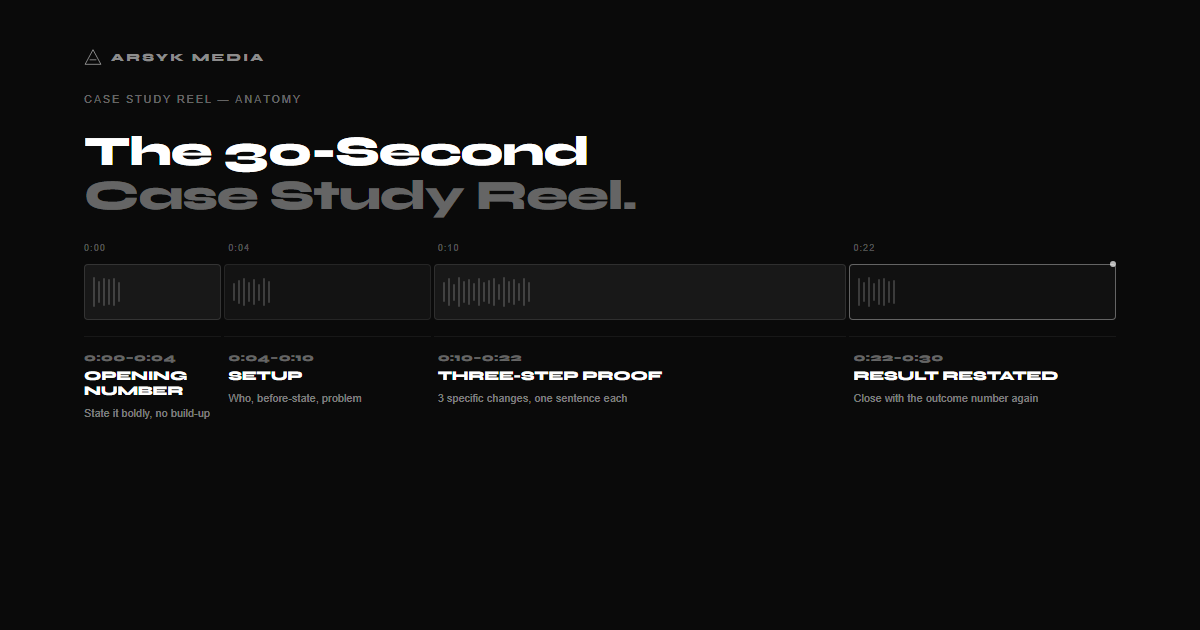
A 30-second Curiosity Case Study Reel:
- 0:00–0:04 — Opening number. State it boldly, on camera or in text. No build-up. The number is the hook.
- 0:04–0:10 — Setup. Who was the client, what was the before-state, and what was the problem the numbers were solving?
- 0:10–0:22 — Three-step proof. What specifically changed? Three beats, one sentence each. No vague "we improved their content strategy." Specific: "We shifted from static posts to three Reels per week using this rotation. We built a Manychat DM funnel triggered by a comment keyword. We ran the first-hour engagement blitz to push the algorithm signal in the first 60 minutes."
- 0:22–0:30 — Result restated. Close with the outcome number again. Repetition is not redundancy here — the viewer spent 20 seconds with the story and now the number lands with context.
Worked Example: Barkat Restaurant
Barkat Restaurant came to Arsyk with 800 Instagram followers and AED 95K in monthly revenue. No paid ads. No viral moments. Just inconsistent posting and a menu that deserved a much bigger audience.
We built a content system — consistent Reel rotation, content pillars anchored to behind-the-kitchen footage, a WhatsApp community of their top 400 customers, and a weekly posting rhythm the algorithm could learn from. No hacks. No giveaways.
That story structures a perfect Case Study Reel. The opening number is the hook. The before-state creates identification with every F&B owner watching. The three-step proof shows mechanism, not just magic. And the result restated at the end closes it with proof. Read the full Barkat case study here.
The Case Study Reel does not work without real numbers. Fabricated or vague stats destroy trust faster than no stats at all. Use what you have actually done, or do not make the claim.
Type 3: The Trial Reel
What Trial Reels Actually Are
A Trial Reel is an Instagram feature that shows your content to non-followers only, making it the primary organic reach tool for business accounts in 2026. Your existing followers do not see it. The algorithm sends it into the discovery feed of people who have no prior relationship with your account.
That is structurally different from a standard Reel, which gets shown first to your followers and then, if engagement is strong, pushed to non-followers. A Trial Reel skips step one entirely. It is pure top-of-funnel reach — and in 2026, where organic discovery is increasingly throttled on accounts that have not yet built algorithmic signal, it is one of the only mechanisms that guarantees cold exposure.
The implication is significant: a Trial Reel that converts cold viewers into followers adds net-new audience to your account every week. Those new followers then see your Authority and Case Study Reels the following week. That is how the three-type rotation compounds.
When to Publish Trial Reels
Minimum: once a week. The plan calls for Friday, and there is a logic to that timing. By Friday, your Authority Reel (Monday) has had its save cycle and your Case Study Reel (Wednesday) has had its share cycle. The algorithm now has a trained signal on your account for that week. A Trial Reel on Friday goes into discovery with stronger account context than it would have if posted on Tuesday.
The Friday trial also means new followers land on an account that already has two strong pieces posted that week. Discovery converts to follows more reliably when the feed looks active and credible on arrival.
The Anatomy of a Trial Reel
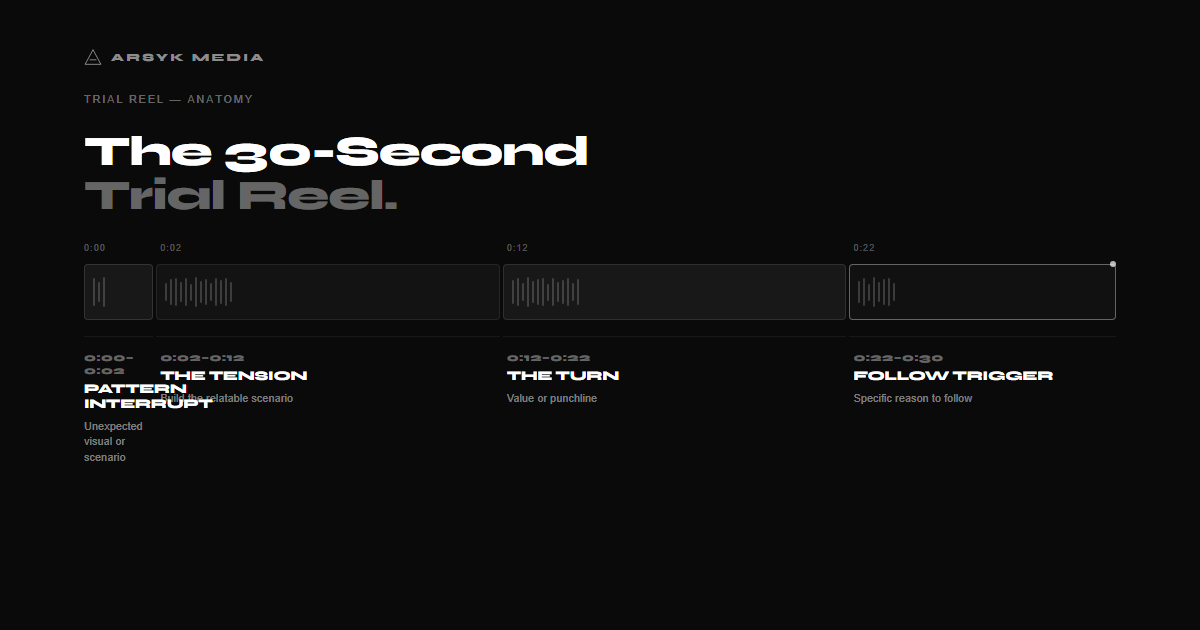
A Trial Reel is built for a completely cold audience. That changes everything.
Cold viewers have not decided to trust you. They do not know your name. They did not come looking for you. The first 2 seconds have to be a pattern interrupt that earns the next 3, and those 3 have to earn the next 5. Every second of a Trial Reel is working harder than the equivalent second in an Authority or Case Study Reel.
The hook cannot be educational. Cold audiences do not care about your framework. They care about their own experience. The hook that works for Trial Reels is relatability — specifically, the bilingual relatability skit format: "POV: a client just said 'just make it go viral, yalla.'" That hook works because it creates identification without requiring prior knowledge of who you are. The viewer laughs, recognizes the scenario, and watches to see how the story goes.
- 0:00–0:02 — Pattern interrupt. Unexpected visual, unexpected statement, or a scenario that creates immediate identification.
- 0:02–0:12 — The tension. Build the scenario fast. If it is a skit, this is the "yes, and" — escalate the relatable premise.
- 0:12–0:22 — The turn. This is where the value or the punchline lives. Give them something worth watching to the end.
- 0:22–0:30 — The follow trigger. Not a save prompt. Not "check the link in bio." A follow trigger: "Follow for the real version of running social media in Dubai." Cold viewers who liked the content need a reason to make the commitment to follow. Give them a specific reason.
Common Trial Reel Mistakes
The most common mistake is making the Trial Reel educational. Cold audiences scroll past education from strangers. They engage with entertainment and identification. Save the frameworks for your Authority Reels, where your existing followers are already primed to save.
The second mistake is no visual hook. A talking head with a white background against 10,000 other talking heads in the discovery feed is invisible. Use unexpected framing, movement in the first frame, or on-screen text that creates curiosity before the audio even starts.
The third mistake is ending without a follow trigger. A Trial Reel that entertains but does not convert to a follow is wasted reach. Every cold viewer who laughs and scrolls is a missed compounding moment. End with a specific, honest reason to follow.
Saw the Reel? Comment TYPES on it — we'll DM you the full 30-day Reels schedule template we run for SMM clients.
→ Instagram: @arsyk.media
The Weekly Schedule: Why This Order Matters
The optimal Reels schedule for business growth is Monday Authority, Wednesday Case Study, Friday Trial — repeated consistently for 30 days. The order is not arbitrary.
Monday Authority builds trust at the start of the week. Existing followers see it first, save it, and those saves push it into the explore feed mid-week. The account starts the week with a credibility signal.
Wednesday Case Study converts that trust into desire. By Wednesday, the Monday Reel has been building saves and reach for two days. A viewer who saw the Authority Reel on Monday and now sees a Case Study Reel showing a real outcome has gone through a mini conversion sequence: trust, then evidence. That is the mental model for a DM or a comment keyword trigger.
Friday Trial brings in new eyes for the next cycle. New followers land on an account with a Monday Authority and a Wednesday Case Study already visible that week. The first impression is strong. They follow. Next Monday, they are in the Authority Reel's first-hour audience, which boosts its engagement signal, which gets the Monday Reel pushed to the explore feed — and the cycle starts over with a larger base.
This is how each round compounds. After 12 Reels (3 per week over 4 weeks), the algorithm has a full training dataset on your account's content type, engagement rate, save rate, and viewer behavior. The 13th Reel starts with better baseline distribution than the 1st did. The system becomes easier to run the longer you run it.
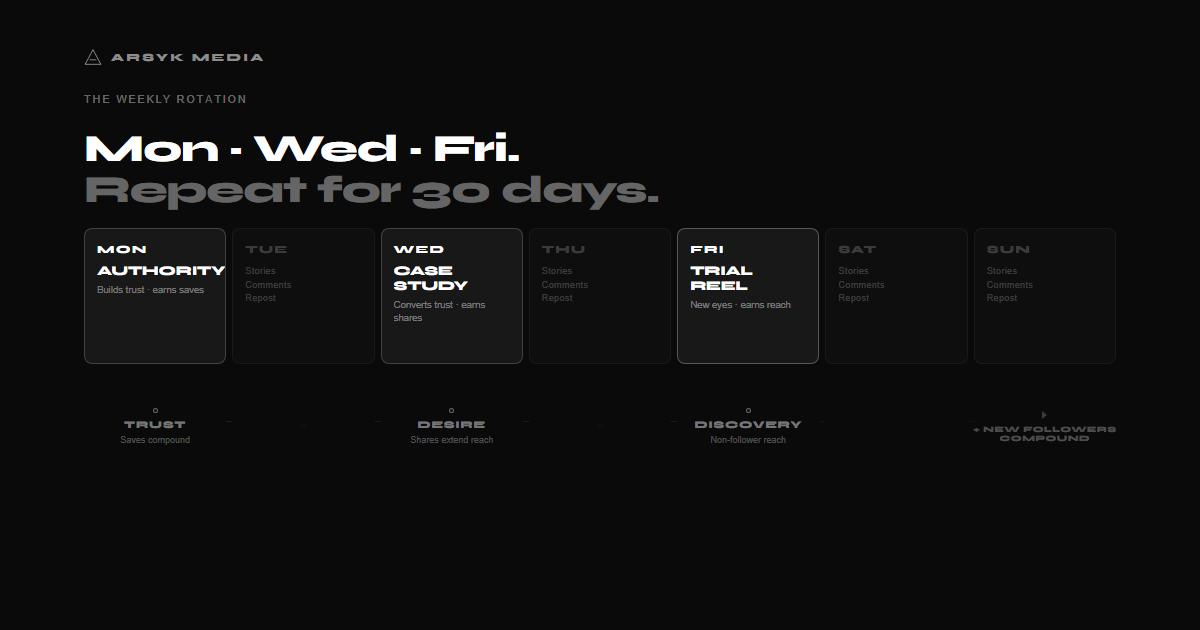
On off-days — Tuesday, Thursday, and the weekend — the work does not stop. Stories reactivate the algorithm's interest in your account daily. Reposting the Monday Reel as a Story tease on Tuesday extends its shelf life. Responding to comments on all three Reels within the same day the comments come in keeps the engagement signal live. The three Reels are the engine. The off-day activity is the fuel.
For further reading on how this rotation fits into a broader Dubai SMM strategy, see our post on social media growth strategies in Dubai.
How We Build This for Clients
We do not hand clients a framework and leave. We run the full system.
For each client on an SMM retainer, we produce a 30-day fully-scripted content plan — every piece tied to a specific service the brand sells, every piece assigned to a specific week slot, every caption written with the correct psychological lever for its type (saves for Authority, shares for Case Study, follows for Trial).
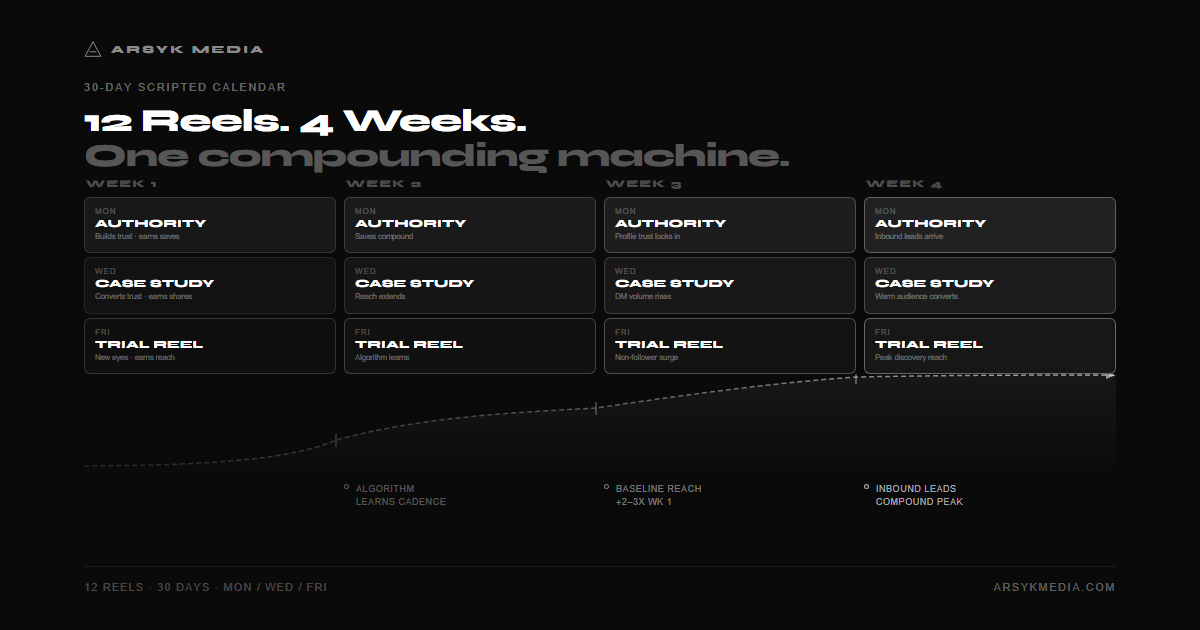
Batch shooting keeps it executable. Three to four shoot days over the month produces 16 pieces. When you script everything before you film, a full month of content can be shot, reviewed, and queued in less time than most businesses spend deciding what to post.
On top of the content itself, we run a 9-tactic organic amplification stack on every piece. Three of those tactics move the needle most:
First-hour engagement blitz. Every team member replies to every comment in the first 60 minutes. This is not busy work. The algorithm reads the early engagement velocity as a quality signal and decides in that window whether to push the Reel to more people. We engineer that signal deliberately.
Manychat DM keyword triggers. Comment a specific word ("TYPES" on Piece #1, for example) and our Manychat automation sends you a free resource via DM. This does two things: it generates DM conversations that Instagram reads as high-intent engagement, and it builds a segmented warm lead list by service interest. By day 30, that list is 500–2,000 warm contacts sorted by what they actually want to buy.
Save-driven captions. Every caption ends with an explicit save prompt. Not "follow for more." Not "link in bio." "Save this and run it for 30 days." Saves are the strongest single predictor of subsequent reach in our client data. The caption is the last line of copy before the viewer makes that decision. We use it.
The full amplification playbook has nine tactics. The three above are the ones that account for the majority of the lift. The rest — Story tease, Trial Reels feature, pinned comment hook, repost cycle, native re-record for TikTok, cross-team comment chain — layer on top.
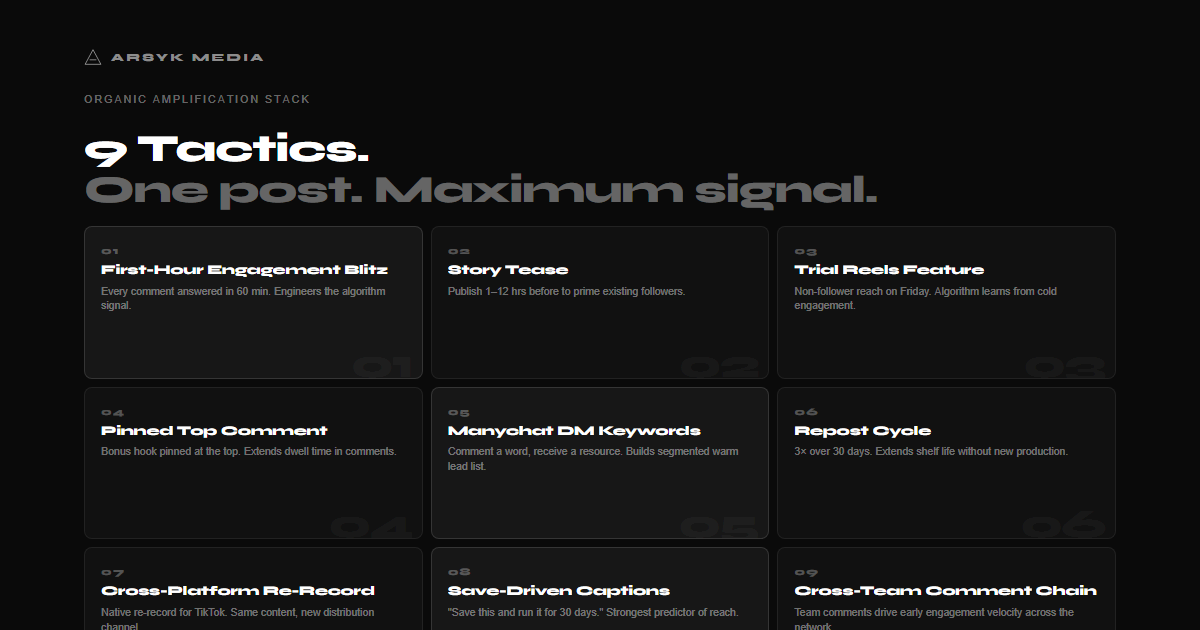
The point is not that the system is complicated. The point is that it is engineered, not freestyled. Every decision has a mechanism behind it. Every piece has a job. That is what separates brand growth that compounds from content that gets posted and forgotten.
Frequently Asked Questions
What are the 3 types of Reels that grow a business?
The three Reel types that drive business growth are Authority Reels (teach a framework you have used — builds trust and earns saves), Curiosity Case Study Reels (show a client result with a number, pain point, and timeframe — earns shares), and Trial Reels (Instagram's non-follower distribution feature — pure top-of-funnel reach). Post one of each per week on a Monday-Wednesday-Friday cycle.
What is a Trial Reel on Instagram?
A Trial Reel is an Instagram feature that distributes your Reel to non-followers only, without showing it on your main feed or to your existing audience. It is designed for reach experiments and top-of-funnel discovery. Instagram uses initial engagement from non-followers to decide whether to push the Reel more broadly. Post one Trial Reel per week for consistent reach expansion.
How often should I post Reels in 2026?
Post three Reels per week: one Authority Reel on Monday, one Case Study Reel on Wednesday, and one Trial Reel on Friday. Repeat this 30-day cycle. Consistency matters more than volume — the algorithm rewards accounts that maintain a predictable posting cadence over accounts that post in bursts.
Should I use original audio or trending audio on Reels?
For Authority Reels and Case Study Reels, use original audio (talking to camera). Your voice and delivery are the authority signal — trending audio undermines the credibility of an educational or case-study format. For Trial Reels, trending audio can help with algorithmic reach since Instagram's non-follower distribution is partly influenced by audio popularity.
How long does it take to grow a business on Instagram Reels?
With a consistent three-Reel-per-week schedule using the Authority-Case Study-Trial framework, most business accounts see meaningful reach growth within 30 days and measurable follower growth within 60 to 90 days. Barkat Restaurant grew from 800 to 2,500 followers in five months using this Reels-first approach, with zero ad spend.
Do I need to be on camera to grow on Reels?
No, but on-camera talking-head content consistently outperforms faceless content for Authority Reels and Case Study Reels because the algorithm rewards watch time, and a human face holds attention longer than text on screen. If being on camera is not possible, process videos (showing how you work) and result-reveal formats are strong alternatives.
What is the difference between an Authority Reel and a Case Study Reel?
An Authority Reel teaches a framework or system you have actually used — it positions you as an expert and earns saves. A Case Study Reel shows a client result using the number-pain-timeframe formula (e.g., a Dubai restaurant going from 800 to 2,500 followers in 5 months) — it creates social proof and earns shares. Both build trust, but through different psychological mechanisms.
How much does Instagram Reels management cost in Dubai?
Arsyk includes the full Reels system in its SMM retainers, starting at AED 4,000 per month for content production, posting, and the 9-tactic amplification stack. Higher tiers add brand strategy, an account manager, and more posts per month. There is no separate add-on charge for the Authority-Case Study-Trial framework — it is how every account is run.
What is the best time to post Reels in Dubai?
Post when your Dubai audience is actually on the app — typically weekday evenings between 7pm and 10pm GST, after work and dinner. That said, the algorithm cares far more about early engagement than exact clock time. A Reel posted at a consistent hour your audience expects, with replies in the first 60 minutes, beats a perfectly-timed post with no engagement.
Do Reels work for B2B and service businesses in Dubai?
Yes. The framework works for service businesses, B2B, and high-ticket offers as well as restaurants and retail. Authority Reels prove expertise, Case Study Reels show real client outcomes, and Trial Reels reach decision-makers who have never heard of you. We run this for auto workshops, salons, and rental businesses across Dubai — the content angle changes, the system does not.
The Offer
You now have the full system. Three types. Weekly rotation. Amplification stack. You can run this yourself.
If you want to run it yourself, start Monday. Film one Authority Reel — bold claim, framework, proof, save prompt. Post it. Track saves, not likes. Do the same Wednesday with a Case Study and Friday with a Trial. After 4 weeks of data, you will know exactly where your account needs work.
If you want Arsyk to run it for you, here is what that looks like:
- Standard — AED 4,000/month. Content production, posting, ad campaigns, 10 posts per platform per month.
- Silver — AED 6,500/month. Everything in Standard plus brand identity, strategy, account manager, 16 posts per platform per month.
- Gold — AED 10,000/month. Everything in Silver plus a fully custom website and AI chatbot, 20 posts per platform per month.
- Platinum — AED 15,000/month. Everything in Gold plus app development and CRM automation, up to 26 posts per platform per month.
Every package includes the 9-tactic organic amplification stack. No extra charge. No "social media team add-on." See full pricing here.
Want Arsyk to Build This For You?
DM us on Instagram at @arsyk.media or WhatsApp us at +971 50 679 5300. Tell us which type of Reel your account is missing — we'll tell you exactly what we'd build first. Khalas, the system is yours.
View Our Packages →