The Brief
Jogavel came to Arsyk Media with a brand position most streetwear founders never get to land — a tagline ("LET'S PUSH THE SCENE FORWARD") that actually meant something to its target audience, a community vocabulary built around "Goats" and "heraldry," and a drop-based release model designed for collectors rather than casual buyers. What they didn't have was a platform that could hold any of that.
Off-the-shelf options were a non-starter. Shopify treats every product the same — a streetwear label that releases 50 numbered pieces and never restocks needs a different storefront than a brand that runs evergreen catalogues. Standard e-commerce templates don't know what to do with a "Today's Goat" daily feature, a community lookbook, or a points system pegged to a brand mascot. Plug-ins exist for some of it, but stitched together they feel like exactly what they are: a generic store with bolted-on personality.
Jogavel needed software that matched the brand voice — built around the drop mechanic, not retrofitted to it.
The Solution
Arsyk Media built jogavel.vercel.app as a fully custom Next.js application deployed on Vercel. Every system on the site — drops, products, loyalty, content, accounts, admin — was designed specifically for how Jogavel actually operates rather than wedged into a templated CMS.
Drop Mechanic
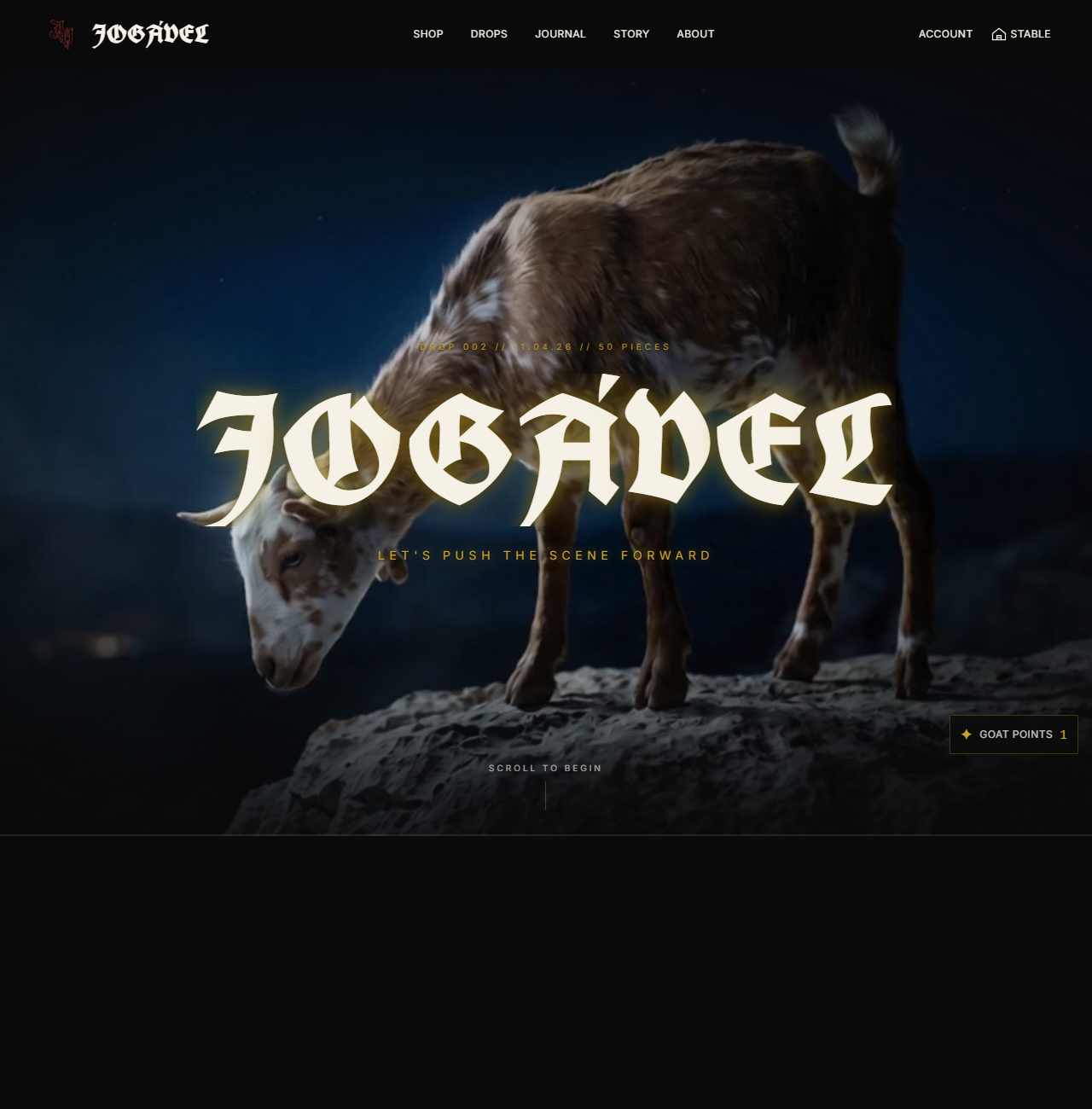
The core unit of the brand isn't a SKU — it's a drop. Each release (DROP 002 is currently live) is a self-contained event with its own page, countdown, inventory pool, and lifecycle. Items are numbered 1 through 50 and never restocked, so the platform tracks each piece individually and burns the listing once sold. This is the drop economy mechanic that made labels like Supreme and Palace defensible — and it's the thing template stores fundamentally can't do.
Shop & Categories
The catalogue is split into five categories — jackets, tracksuits, tops, bottoms, accessories — with photography and category navigation that gets out of the product's way. Cards show what matters (the piece, the price, whether it's part of an active drop) and skip the ten-row spec sheet that bigger e-commerce sites pad pages with.
Goat Points Loyalty
Jogavel's loyalty system isn't a generic points-for-purchase cashback scheme — it's "Goat Points," named after the brand's community vocabulary and integrated as currency you can use at checkout. The system tracks earnings across drops, content engagement, and referrals; balances live in the customer account dashboard. This is the kind of feature most brands outsource to a third-party loyalty plugin and end up with a bolt-on UI that looks nothing like the rest of the site. We built it native.
Lookbook & Today's Goat
"Today's Goat" is a daily-rotating editorial feature that gives customers a reason to come back to the site between drops — fashion content has a half-life problem, and the daily cadence is what keeps a streetwear community engaged when there's nothing to buy. The lookbook section runs alongside it as the brand story canvas: who's wearing what, what the drops mean, the editorial layer that turns a clothing brand into a culture.
Account & Authentication
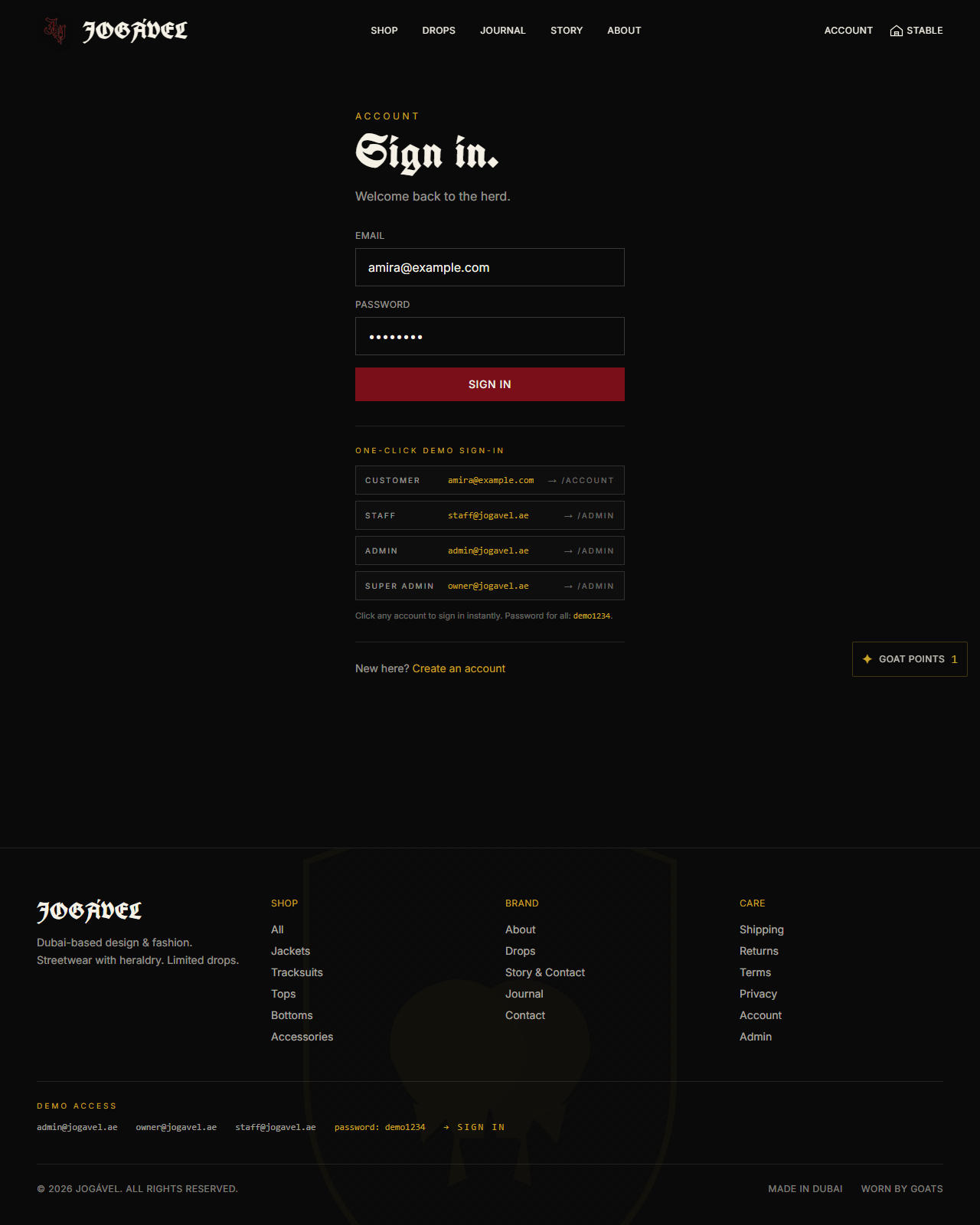
Customers get persistent accounts with order history, Goat Points balance, drop access privileges, and saved addresses. A demo sign-in route exists at /account/signin for previewing the experience. Auth is handled with secure session tokens and integrates cleanly with the order pipeline.
Admin Dashboard
Behind the storefront lives a custom admin surface for the Jogavel team — drop creation, product editing, inventory management, order processing, customer service, and analytics. The team uses three role-based accounts (admin@jogavel.ae, owner@jogavel.ae, staff@jogavel.ae) so permissions and workflows scale as the team grows. Every operational task that would otherwise require a Shopify subscription, a Klaviyo subscription, and a stitched-together loyalty SaaS lives in one dashboard.
What We Built
Why It Works
The thing about streetwear is that the platform IS the brand experience — it's not a marketing site that points to a separate store. When a drop goes live, customers should feel like they're inside the world Jogavel is building, not redirected to a Shopify checkout that looks identical to every other label they've bought from. Every piece of friction breaks the spell; every template element pulls the brand a little closer to looking like everything else.
Building the platform custom on Next.js + Vercel meant Arsyk Media could match the brand vocabulary at the system layer — "Goat Points" isn't a label slapped over a generic loyalty plugin, it's the actual data model. "DROP 002" isn't a product collection, it's a first-class entity with its own lifecycle. That fidelity is what separates streetwear labels with culture from streetwear labels with a Shopify store.
"The drop mechanic finally works the way we always pictured it. Every release feels like an event, the loyalty system means something to the community, and the admin dashboard makes the operations side actually fun. Arsyk built it the way we'd have built it ourselves if we were engineers."
Key Takeaways
Jogavel is the case study for "the platform is the brand." Streetwear, limited-edition watches, indie publishers, NFT-adjacent fashion — any business model where the release itself is the marketing event needs software designed around that release pattern, not bolted onto a generic e-commerce template. Templates can launch you. They can't grow you to where Jogavel is heading.
The other lesson: custom isn't expensive when the alternative is paying SaaS rent across five different vendors (storefront, loyalty, email, drops, admin) every month for the rest of the company's life. A custom build with a clean ownership model usually pays itself back inside 18 months — and the brand gets to keep the platform.
Building Something Like This?
Custom e-commerce, drop platforms, loyalty systems, and admin dashboards — built on Next.js, designed to match your brand's actual mechanics, not a template's.
View Our Packages